

On Cultivation
Jiu jitsu; turkey hunting, turkey failing; mental maps; turkey and waffles.

My jiu jitsu professor texted me last week — Where have you been? I had to explain, awkwardly over text, that we’re in the midst of turkey season, that I’ve been away on vacation, that I’m deep in the throes of projects and parenting and punch-outs. He responded with the “laughing” reaction, pointing out that he liked turkey. I laughed, too, and told him I did as well, that I just need to kill one, and that I’d be back soon.
I’d been waiting for that text, not having been in the gym for two-and-a-half weeks. Life, as Ferris Bueller liked to say, moves pretty fast. And, to avoid missing it — or sending a Ferrari flying out a window — I had to take stock of my own, make a determination on how things stack up. I did that, and, perhaps unsurprisingly, realized that I like hunting more than I like jiu jitsu.
Hard to believe it, though, with the turkey season I’ve been having. Four “real” hunts — ones where I was up pre-dawn, nursing coffee, listening to the world come alive: the crescendo of bird calls, robins building to catbirds and song sparrows, pewees and titmice, red-winged blackbirds and common grackles, climaxing with the warblers and wrens and then, finally — if I’m lucky — turkeys. The tree yelps and gobbles, the flap of wings and rustle of leaves. The spitting and the drumming and the scratching and strutting. Heart-pounding. Infuriating. Infuriating because you hear that — you see them, sometimes, once, even — but they’re across the rock wall or they’re down the rise or over in the other field, or you’re set up with your back against a downed tree and they’re promenading behind you, these birds with remarkably, otherworldly, omnipotently good eyesight unable to see your decoy just behind the moss and rot and mulch and duff. Didn’t see you, at least — not that it helps — but then that throbbing in your chest starts to fade and the thrumming stops and you’re left wondering how the hell a bird so dumb can be so smart.
I turned to John Gonter at one point last week and remarked that it’s a good thing I like deer hunting more than I like turkey hunting — otherwise I’d be significantly more frustrated.
Driving home the other morning — home before the kids even were awake — the benefit, I suppose, of failing to catch birds after fly down on a small suburban parcel — I reminded myself that I went an entire first season without even seeing a huntable deer, killed my first one the next season after putting in almost three months of sitting in one spot, have really only found success at a location after I’ve put in the time to learn the property. I’ve spent my turkey seasons so far bouncing from spot to spot, chasing the thrill of gobbles — but not stopping to look around at the places I’ve been. I’ve recommitted myself for the last two weeks of the season to build a web of awareness, and — if not to bag a bird — to not miss it, miss anything, miss everything, miss all of it.
Earlier, as I walked back to the car from my blind, I stopped to watch a hawk circle overhead, land in a pine, watch, wait — the chorus of alarm calls from the jays and sparrows and chickadees acting as the finale to my morning.
***
Tamar Haspel writes in her book To Boldly Grow about the ability we have to notice things, even at high speed. She writes of her husband, a former trader who spent his days calling orders from the chaos of the trading pit, and how, even while driving, racing down Cape Cod county roads, he would lean over and ask — did you see those oyster mushrooms back there? How about the patch of ferns? Haspel wonders at this — how his brain can work so much differently from her own, attending to such flashes of information with detail, while hers leaves them entirely unnoticed. It is of mental maps, like Peter Korn
standing in the bench room at school, oblivious to the cacophony of mallets pounding on chisels and the whine of saw blades and planer knives emanating from the machine room next door, until suddenly a quiet ker-thunk sends [him] flying through the swinging doors into the machine room to see if anyone has been hurt.1
That nondescript noise triggered his mental map, which “isolated the sound of a piece of wood kicking back on the table saw,” and sent him running. These filters, this biological adaptation, shade our perception — “a non-woodworker’s map might not have picked up the sound at all.”
And so it comes down to us to cultivate our own mental maps with that which matters to us: The Monkey’s cries in the middle of the night; Mrs. CWD’s smile; a turkey’s gobble; the woof and crunch of a deer in fall; the break in the swell; real wood as opposed to laminate; calloused hands and a firm handshake; Kiddo’s pause in playing; the Warthog’s potty dance; the change in pitch just before bacon starts to burn; the smell when onions begin to caramelize; the U-shape of a fern’s stem; the leaves of three on the trail edge; the moment of transition from an arm bar to a triangle to an omoplata; the feeling in your gut when you have just a little more to give. All these things, we cultivate — all these things, we stop to collect.
***
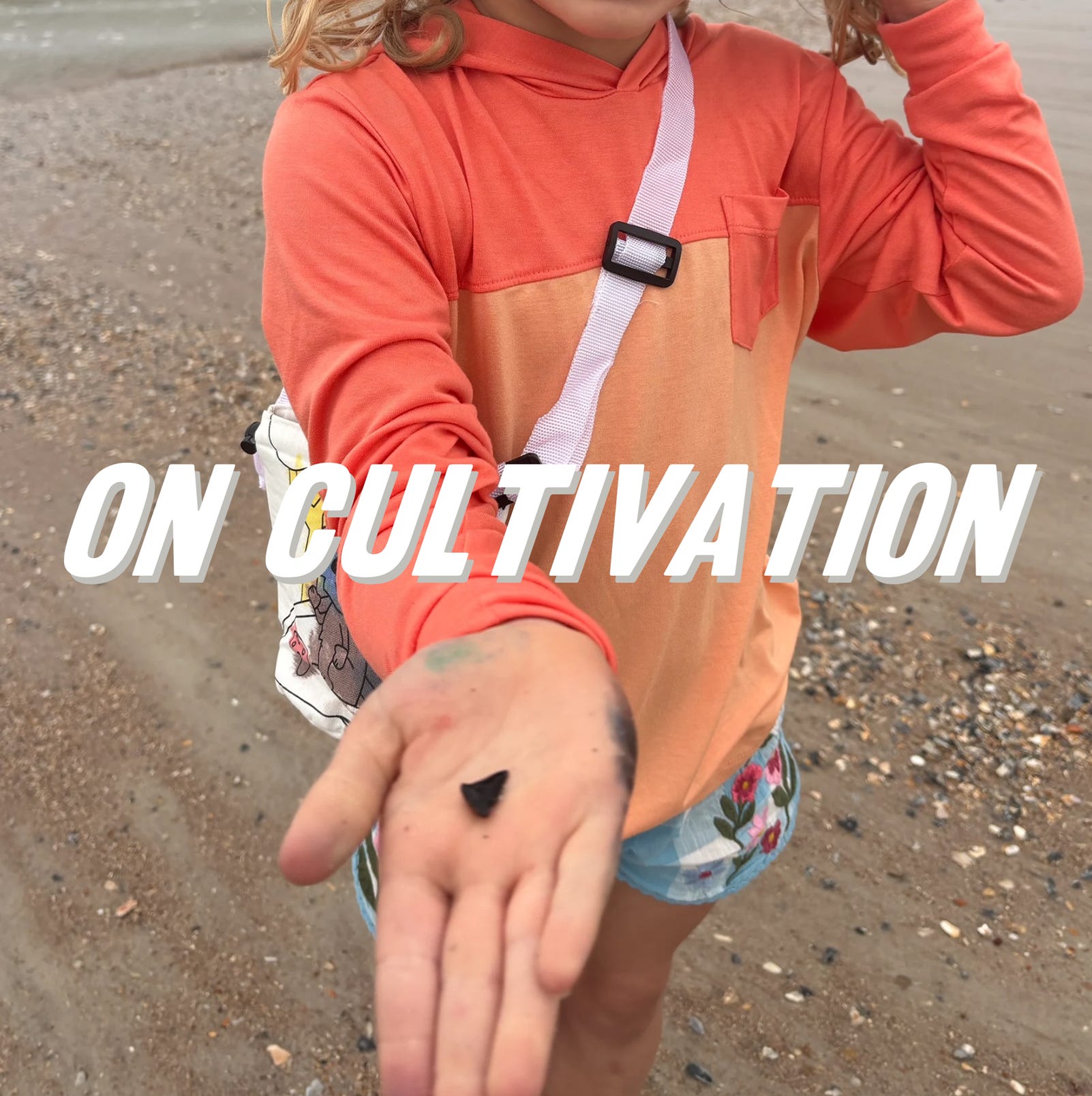
As we were walking the beach in Florida one morning, the resort’s naturalist told Kiddo how you find shark teeth: it’s all about pattern recognition. Look for shiny, black triangles, and, eventually, you’ll find your prize. Kiddo nodded, shifted down her gaze. What seemed like minutes later, she held a tooth in her palm.

We’ve been on an eating tear of late, working through the bounty from John. For Mother’s Day, seared duck breast over grits, with a tomato-bacon-onion pan sauce; the next day, “fried” turkey nuggets over blue cornmeal waffles. We called them “Unicorn Waffles” and the kids ate three apiece.
If you have wild turkey, blue cornmeal, and sourdough division, you could recreate it exactly like this — otherwise, feel free to substitute chicken (or domestic turkey), regular cornmeal, and your standard waffle recipe.2

Start with the turkey breast, cut into one- or so- inch pieces. In a large mixing bowl, combine two cups of buttermilk (I used kefir, since we’re swimming in it), a hearty splash of pickle juice, a glug of hot sauce, and a splash of liquid whey (if you have it). Stir in salt, pepper, garlic powder. Marinate the breasts for at least thirty minutes, and up to eight or so hours.
While the turkey is marinating, you can make the waffle batter. I used our classic “Weekend Waffle” recipe, but subbed half the flour for blue corn meal, swapped the eggs for about a tablespoon of flax seed meal and extra liquid whey, and used maple syrup instead of sugar. You can make the waffles however you’d like.
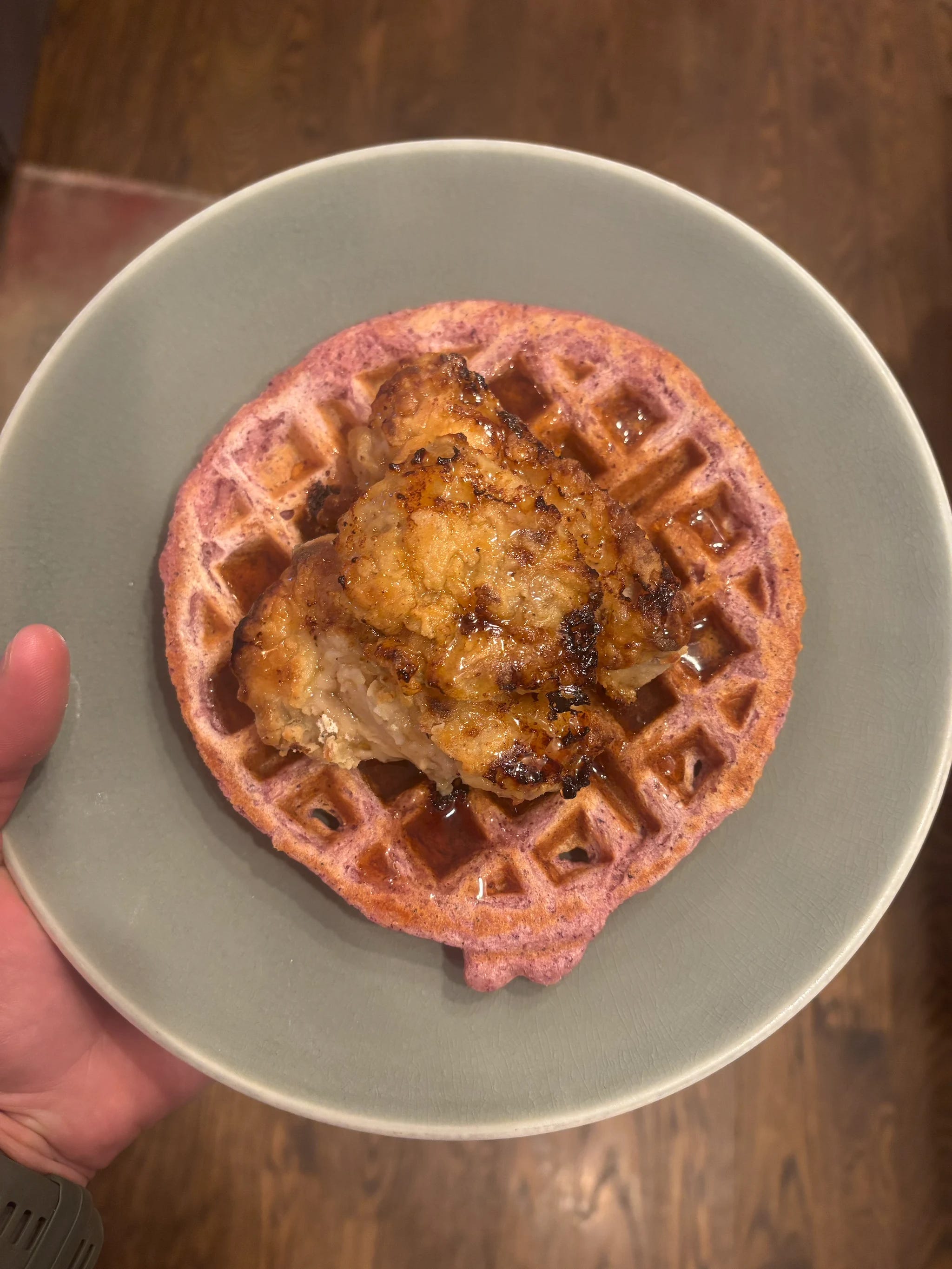
When ready to cook, dredge the turkey bits in a mixture of 4:1 flour to rice flour, seasoned with salt, pepper, hot paprika and garlic powder. From here, you can either fry in oil — as you would traditionally — or cheat, like I did, and place the nuggets in a ripping hot cast iron with bacon fat, then place the lot in a 400°F oven for about fifteen minutes, until cooked through, flipping halfway.
Serve the turkey over the waffles, and douse the whole thing with maple syrup.
There you go folks, turkey and waffles. A lovely treat for turkey season. I’d love to make it again, next time using my own bird. A man can hope — two weeks is plenty of time for redemption.
As for Team CWD, we’ll be spending it with Beeba and Papa, Auntie CWD, Uncle Steady, and the Cousins CWD — maybe finishing our planting, maybe making mischief.
Whatever you cultivate this weekend, I hope you do it intentionally.
We’ll see you back here next week.
From Why We Make Things and Why It Matters.
This is loosely adapted from Jesse Griffith’s fried turkey recipe — though I lent my copy of the turkey book to a friend and haven’t got it back — so I’m going mostly off memory and vibes.
And then there is the flip side, which is often more true—how the hell a person so smart can sometimes be so dumb? Life is full of surprises!
Love the concept of mental maps. I think that's how our dogs think all the time.
I agree with the dumb bird thing, although I am generally thinking how the hell a person so dumb can be so smart, in my daily interactions. I guess being smart is relative. I don't mean to sound cruel, but you are a much more tolerant person than I.
I love you, and really enjoyed reading your thoughts this week. I have been wondering what it's like to be on a turkey hunt. Seems like they show up frequently whenever I am in the woods (infrequently), but obviously not the time or place to actually "get" one.